Projection Experiments
Projection Design · Interaction Systems
I explored projection through a series of experiments examining how spatial layout, timing, and viewer interaction could support meaning-making within installation contexts. Using site-responsive projection setups, I tested how images could be shaped and sequenced in relation to architectural surfaces and audience movement. These studies approached projection mapping as a spatial medium rather than a purely technical tool, focusing on its potential to mediate perception and narrative through embodied experience.
Full Produciton
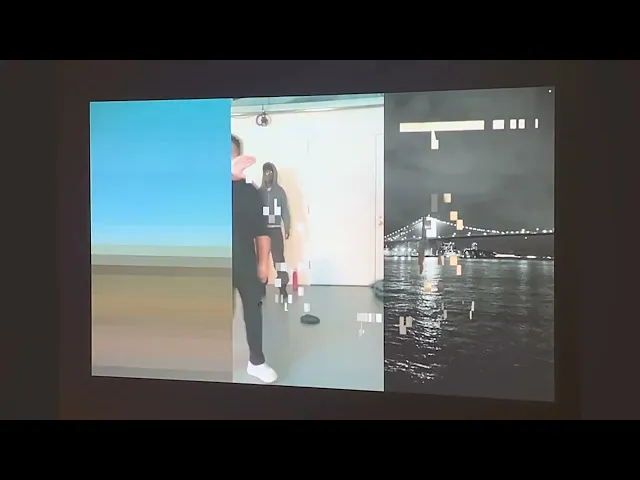
This installation examines existence as the accumulation of perception and memory through an empiricist lens, where identity is continuously formed through fragmented cognition. The work layers three temporal states: directional moving imagery suggesting progression, a live camera feed capturing the present moment, and static images representing the past. Fragmented human silhouettes emerge across these layers with slight temporal delays, constructing shifting overlaps that emphasize the instability of self-perception across time.
Projected onto the wall, the visuals respond to audience movement through interactive triggers, allowing the live camera layer to merge with the pre-composed imagery. As viewers enter and move within the projection field, their presence becomes incorporated into the visual system, activating new fragmentary compositions. The installation invites reflection on how time, perception, and memory intersect to shape an experience of the self that is never singular or fully continuous.
Developed the interaction systems in TouchDesigner, assisted with installation, and contributed to the project ideation.
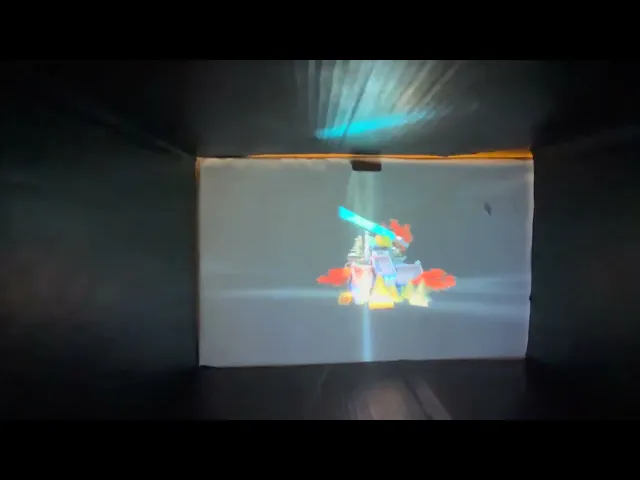
This project explores childhood memory as an emotional yet fragmented form of recollection rather than a continuous narrative. Memory is treated as something both intimate and elusive, shaped as much by objects and spaces as by events. Developed collaboratively by gathering personal motifs from each team member, the visual language centers on 3D-rendered objects drawn from remembered childhood environments, such as a Buddha figure, handwoven bags, and canoes. These objects function as anchors for reconstructing personal and spatial narratives.
The installation creates a physically compressed viewing environment that requires the audience to lean in and adjust their perspective to see the work. This spatial constraint reflects the experience of revisiting childhood spaces that often appear smaller than remembered. By shaping the viewing conditions in this way, the project investigates how proximity can paradoxically obscure clarity, mirroring how distant memories become harder to fully grasp the closer they are examined.